Choking emergencies can escalate quickly, and knowing exactly what changes once a victim loses consciousness is one of the most important distinctions in emergency response training. Many rescuers understand how does CPR differ in an unresponsive adult choking victim less clearly than they think, since the sequence shifts in a few critical ways from both standard CPR and conscious choking response. Understanding these differences ahead of time, rather than trying to recall them mid-emergency, can make a meaningful difference in outcomes.
While a choking victim remains conscious, the standard response involves back blows and abdominal thrusts, alternating between the two to help dislodge the obstruction. This changes the moment the person becomes unresponsive. At that point, rescuers should carefully lower the victim to the ground, call for emergency services if this has not already been done, and begin CPR immediately, starting with chest compressions rather than continuing abdominal thrusts. Abdominal thrusts are not effective or appropriate once a person loses consciousness, making this transition one of the most important moments in the entire response sequence.
The core cycle in this situation follows the same structure as standard adult CPR: thirty chest compressions followed by two rescue breath attempts, repeated continuously. However, one key modification applies specifically to choking related CPR. Before each attempt at rescue breaths, the rescuer should briefly open the victim’s mouth and look for any visible object blocking the airway. If an object is clearly visible and easily reachable, it should be removed. If nothing is visible, rescuers should proceed directly to attempting rescue breaths rather than searching further.
This visual check is an important distinction from standard CPR, where no such repeated airway inspection is required between compression cycles. In choking related CPR, checking the mouth before each breath attempt helps rescuers determine whether the airway has cleared enough to allow air to pass, and it also creates a natural opportunity to remove an obstruction if the compressions have helped dislodge it.
One point that cannot be emphasized enough in this process is the importance of avoiding blind finger sweeps. A blind finger sweep, meaning sweeping a finger through the mouth without being able to see an object first, carries a real risk of pushing the obstruction further down the airway rather than helping clear it. Objects should only ever be removed if they are clearly visible and can be reached without difficulty. This rule applies consistently across choking and CPR training standards and remains one of the most commonly misunderstood aspects of emergency airway management.
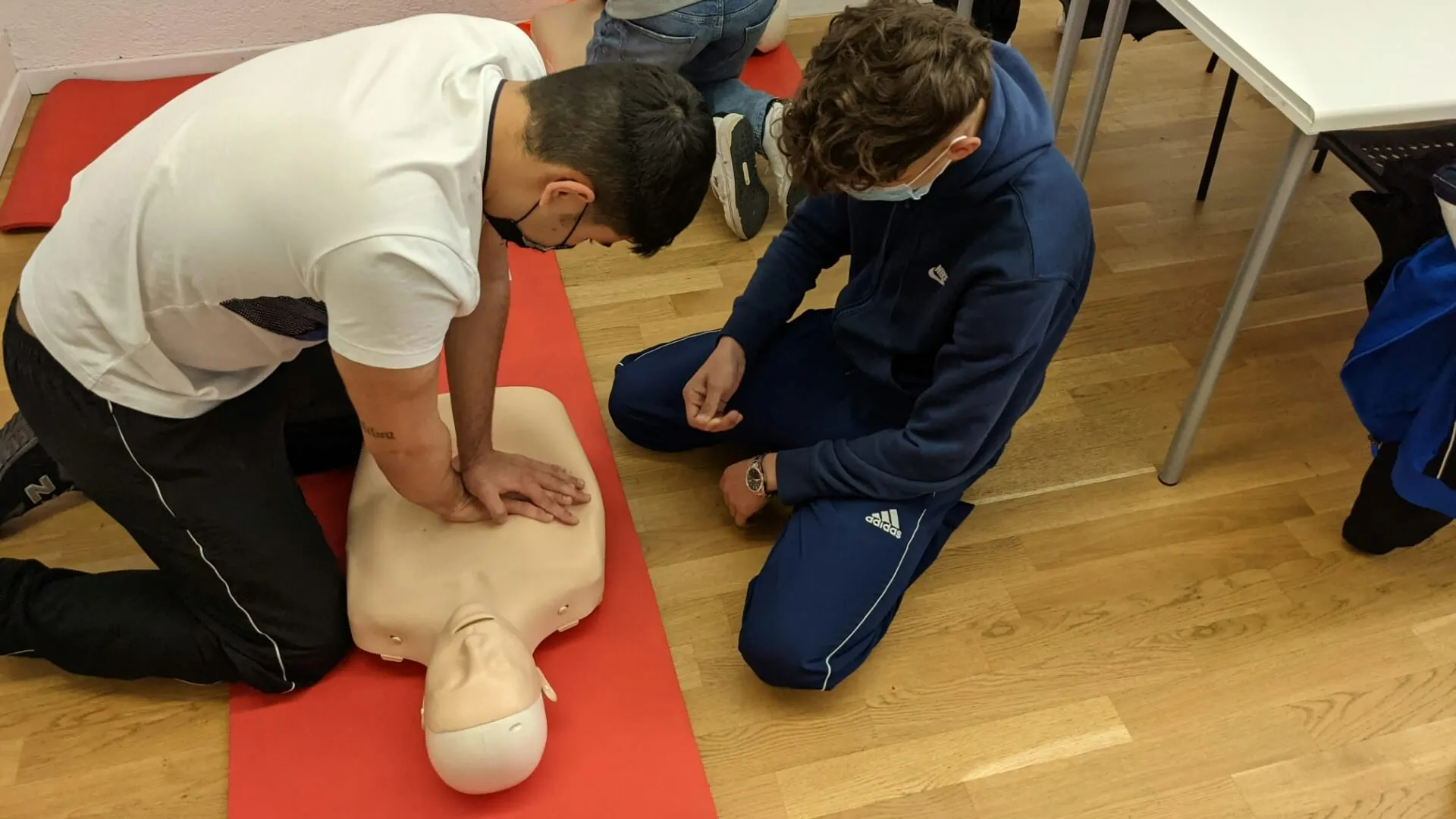
Compression technique itself does not change based on the choking context. Rescuers should place the heel of one hand at the center of the chest, between the nipples, with the second hand layered on top and fingers interlaced and lifted off the chest wall. Compressions should be delivered hard and fast, at a depth of at least two inches for an average adult, at a rate of 100 to 120 compressions per minute. The physical technique mirrors standard CPR closely, but the underlying goal is twofold in this scenario: maintaining circulation while also using the compressions themselves to help dislodge the obstruction, something that would not be a consideration in cardiac arrest CPR performed for other reasons.
Rescuers should continue this compression and airway check cycle without unnecessary interruption until one of several outcomes occurs: the person regains consciousness and begins breathing effectively on their own, an AED becomes available and can be applied per standard protocol, or trained emergency responders arrive and take over care. Stopping too early, whether from exhaustion, uncertainty, or a mistaken assumption that the obstruction has cleared, is one of the more common and preventable errors that can reduce a victim’s chances of a positive outcome.
For healthcare professionals, childcare workers, fitness instructors, and caregivers alike, understanding this sequence clearly before an emergency happens is what allows for calm, decisive action when it matters most. Reading through the steps is a useful starting point, but hands-on practice under proper certification training builds the muscle memory and confidence needed to respond correctly under real pressure. Those looking to build or renew this critical skill set can find structured, up-to-date CPR and BLS certification training through Simple CPR, designed to prepare healthcare professionals, caregivers, and the general public alike to respond effectively when seconds matter most.